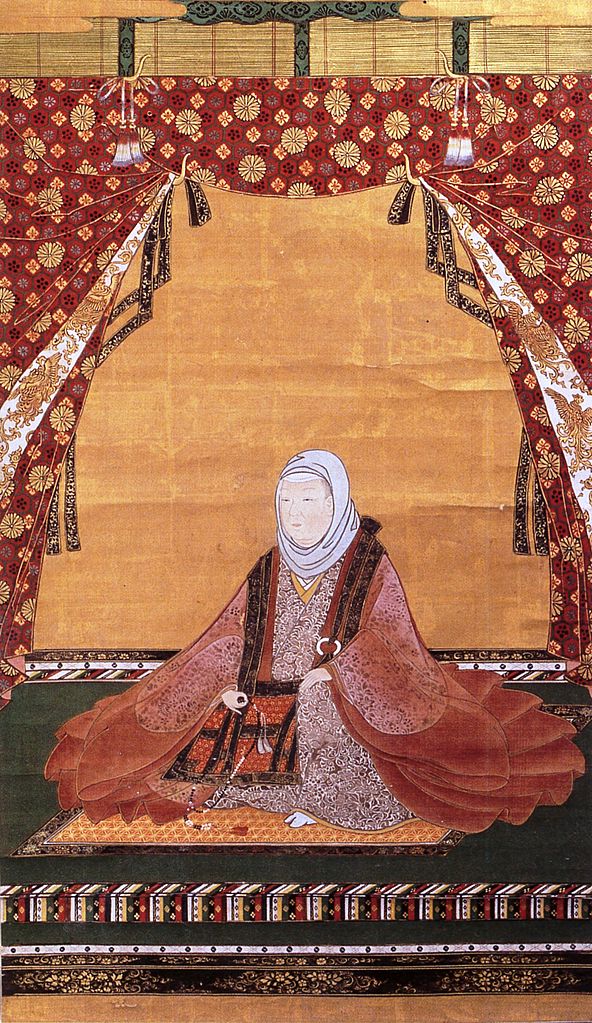
In 1584, two years after Oda Nobunaga’s death, a war broke out between his ally, Ieyasu Tokugawa, and his general, Hashiba Hideyoshi. To end the conflict, Hideyoshi decided to marry his half-sister Asahi-hime to his rival.
Nothing new so far: peace and alliances have been sealed with marriages in different times and parts of the world. What is interesting in this case is that Asahi-hime was already married, forcing the breakup of one marriage to make way for another. We have three stories of how this happened. I will list them based on Arthur Lindsay Sadler’s biography of Ieyasu:
(1) One says he was one Saji Hyuga-no-kami, and that he committed suicide owing to the slight put upon him by the unceremonious recall of his wife. [This version seems to be the most widely accepted]
(2) Another calls him Soeda Jimbei, commander of the fortress of Tai in Tajima, and relates that she was taken away from him because he lost his castle and that he did not complain. And since many lost what was more irreplaceable than a wife under these circumstances, he would have no reason.
(3) Again, a more pleasing version has it that Soeda, who was now the lord of Karasu-mori in Owari, waived his claim to his wife and gave her up gracefully at Hideyoshi’s request, because she was needed for greater things—the unification of the Empire, to wit. And that Hideyoshi generously offered him an income of 50,000 koku as a solace, but that he refused all reward, retired from active life, and became a recluse.
Another interesting episode concerning women and diplomacy is also related to the tense relations between Ieyasu and Hideyoshi: the former did not want to go to the capital to submit to the latter. To reassure Ieyasu that nothing would happen to him, Hideyoshi sent his own mother as a hostage. The pretext was that she would visit her daughter, who was married to Ieyasu, thus placing her at his mercy. It paid off, and Ieyasu finally went to the capital.
In these examples, women resemble chess pieces, passively moved by their male relatives. However, women were also active players in political intrigue and negotiation.
On the Tokugawa side, Lady Acha was sent by Ieyasu to negotiate with Yodogimi during the siege of Osaka in 1615. Conversely, the Toyotomi had previously sent Ohatsu (Yodogimi’s sister) to negotiate with Ieyasu. And, of course, let’s not forget that Yodogimi herself led the political opposition to the rising power of the Tokugawa.
Whether actively or passively, women were deeply involved in politics and diplomacy during the Sengoku period, and their role should not be overlooked.


 Robert Nakamura
Leave a comment