The second chapter of Ronin: The Wolf’s Path plunges readers into a fierce battle as Zasuro leads the Natsaka clan’s assault on a Yushuma clan castle. During this siege, Sengoku-era weapons and equipment appear that many readers won’t be familiar with. Which siege weapons are authentic to the period, and which are creative liberties?
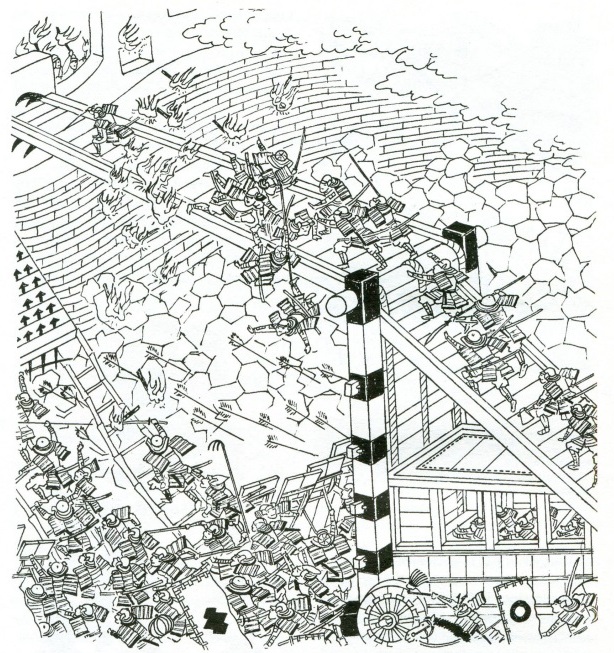
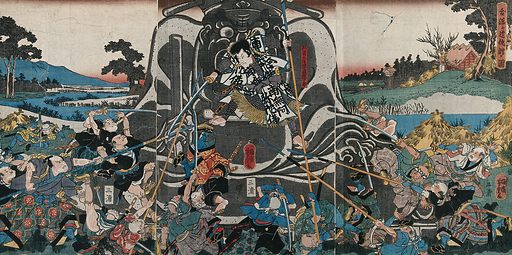
The chapter begins with the collapse of part of the outer wall (sannomaru) thanks to sappers who managed to dig under the rampart and, after replacing its foundations with wooden ones, set fire to them before escaping. The sappers succeeded despite the rain of projectiles falling on them thanks to the protection of a kikkosha. This kikkosha, also known as kamikosha or kamekosha (in reference to the turtle) is described in the novel as “an armored wagon covered in fur that offered excellent protection against stones, arrows, and fire (…)” and was ruined after fulfilling its purpose. The image below shows what this type of cart would look like.

The defenders, far from being defenseless, have their own war machine, the hassekiboku, also known as hoseki: a light trebuchet used to hurl stones at the enemy.
One of my beta readers, upon reading about this weapon, asked me “why do the defenders use a trebuchet? Shouldn’t the attackers use it?” It’s a good question, since in Europe that would have been the case. In Japan, however, the hassekiboku, being a light trebuchet, was primarily used as an anti-personnel weapon. That is, to attack armies rather than fortresses.
Something that also caught my reader’s attention was that, at the end of the chapter, when Zasuro’s troops take the castle’s inner wall (honmaru), it’s discovered that the machine was being operated by women and children, something he considered implausible. However, that’s exactly what happened in the siege of Omori in 1599, though the range of their projectiles was reduced to a third of what it would have been with trained professionals (the novel indicates that when they reached the inner ring, women and children operated the machine, though it’s not clear if this was the case at other moments of the siege). During sieges, it was common for non-combatants to participate in the defense, especially when the situation became desperate. Women and children often operated defensive equipment, carried ammunition, or helped with repairs. That said, his skepticism is understandable, and I fear other readers may harbor the same doubts, though I hope their curiosity will lead them to read this article to clear them up.
Although references to this machine exist in chronicles, no drawings have survived, so books on the subject are generally accompanied by this Chinese illustration, as in the case of Siege Weapons in the Far East Volumes I & II, by Stephen Turnbull, books I used as the basis for this chapter (outside of Turnbull’s books, WarHistory.org has the best article you can find on the internet). I understand that many people don’t like Turnbull for a variety of reasons I won’t address here, but he has written the most accessible monographs on the subject.

The castle’s central wall (ninomaru) was taken by several siege ramps known as cloud ladders. The novel describes them as follows:
…massive wheeled bridges with hooks at their upper ends to anchor into the wall, creating an inclined path for soldiers to climb. Large wooden screens suspended from above would protect the initial wave of attackers, with engineers at the rear to adjust them. The hollow core of each ramp held additional soldiers ready to replace fallen comrades. If positioned well, the ramps would bridge the moat once anchored.
The descriptions I found are contradictory. Turnbull claims that Japanese models didn’t have wheels, unlike the original Chinese cloud ladders. However, in the image below (which Turnbull includes in his own book) we can see a Japanese model that does incorporate them. It’s possible this is because it was built during the Korean War, and that wheels weren’t usual in Japan. Be that as it may, in my novel the ladders incorporate wheels.

Where I took a small liberty was with the mobile shields. Generally these suspended screens to protect attackers constituted a separate machine. However, to simplify, I joined them to the front part of the siege ramp, something that although not documented, is quite plausible.

Finally, when Zasuro and his men take the first ring (honmaru) and reach the tower, they destroy the gate with hammers. Battering rams were uncommon, and were generally used individually, something illustrated in the Toyotomi Kunkoki (below).

As you can see, the siege described in the novel’s second chapter is well documented despite being a fantasy novel rather than a historical one. The part that reveals the fictional side of the episode lies in the speed of events: once the outer ring is taken, the siege ends in a matter of hours, while historical sieges generally lasted much longer. However, I wanted to write a chapter of frenzied action, and as Brandon Sanderson often says, when in doubt, “err on the side of awesome.”




Leave a comment