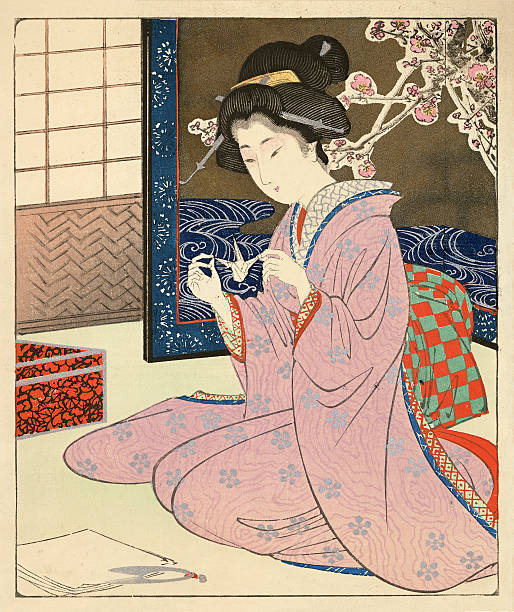
The original/historically appropriate name was Rin. See The Challenge of Sengoku Names for an explanation of name choices.
The Hachiman Dogs aren’t just a band of warriors, but also include a female section. While most serve in logistical support roles, five women regularly get their hands bloody in different capacities. In this article we’ll examine one of them: Hiroko.
Hiroko’s Story
Although most characters see Takeshi, the band’s leader, as a ruthless monster, Hiroko considers him her savior. Brutally abused by her parents, Hiroko managed to escape her torment at the age of eight thanks to the ronin’s intervention, when he ended both their lives. Despite the fact that Takeshi killed them to settle a score (saving the girl was just an unintended consequence), he decided to spare Hiroko and take her with him, eventually making her his adopted daughter in all but name.
After years working alongside the other women in the band, Takeshi assigned Hiroko the task of finishing off the wounded during their raiding expeditions. He’d already seen her lethal skill with the knife. But how did Takeshi discover this talent?
The severe abuse Hiroko suffered as a child left her with irreversible psychological damage, and the fact that Takeshi, during her rescue, lent her his wakizashi so she could finish off her own mother, probably made things worse. Once she reached adolescence, Hiroko would confuse certain middle-aged couples with her parents, set traps for them, and stab them to death. She’d realize her mistake afterward and be horrified by her own actions, but the cycle of confusion and murder would repeat itself. One reason Takeshi assigned her this new position was to keep her under closer watch, since Hiroko actions not only put her in danger, but could create problems for the entire band.
Historical precedents
The term “serial killer” wasn’t coined until the 20th century, but historical figures show similar patterns. The most famous are Gilles de Rais and Countess Bathory, but there are many others. In the case of Japan, the killer who best fits the modern concept is the so-called “Spear Killer” from the Edo era, who claimed to have killed for the first time to test his spear (a known practice) but then couldn’t stop.
While I haven’t found women in this category in feudal Japan, the Chronicle of Nobunaga contains this curious case of a female criminal:
The wife of a township gatekeeper in the Banba ward of Lower Kyoto had for a long time been kidnapping women and had sold a large number of them in Sakai in Izumi Province. When Murai Shunchōken [Sadakatsu] got wind of this, he had her arrested and an investigation conducted. She made a statement to the effect that, woman as she was, she had by then sold as many as eighty persons. So she was put to death.
With these precedents, I decided to create a character readers could recognize as such without actually using the term.
The serial killer
Hiroko suffers from psychotic episodes mixed with something like Fregoli syndrome, where victims get mistaken for other known people (in Hiroko’s case, her parents). But this type of killer doesn’t usually collect trophies, and I wanted to add that element. How to bridge this gap?
Every time Hiroko murders a couple she confuses with her parents, she experiences it as if it were the first time. She collects locks of hair from the victims, crossing and joining them in an X shape to form a “butterfly.” But when she realizes she killed the wrong people, she discovers she has other “butterflies” connected by a thread, forming a string. The new trophy joins the previous ones not because they give her pleasure, but as a shameful reminder of the times she lost control, hoping it won’t happen again. It’s essentially a compulsive ritual: an unconscious way of staying connected to reality and punishing herself.
Her Relationship with Takeshi
Hiroko can’t find any fault in Takeshi, whom she loves as a father. Even so, she once angered the ronin so much that he decided to remove her from the band by finding her a husband. Hiroko accepted the arrangement and married a widowed peasant who needed a hardworking woman. But marriage didn’t solve her mental problems. Soon, murders of middle-aged couples started happening in the village, and suspicions focused on the newcomer and her past with the ronin. Hiroko was forced to flee to save her life.
Unable to lead a normal life, Takeshi readmitted her to the Hachiman Dogs, where her crimes get buried in the violence that follows the group everywhere. At the beginning of the story, Takeshi and his men receive the opportunity to become samurai, but Hiroko’s behavior could sabotage everything. In the novel, we’ll see whether Takeshi decides to sacrifice his adopted daughter for pragmatic reasons, or if the affection he’s developed for her over the years wins out.


 Robert Nakamura
Leave a comment