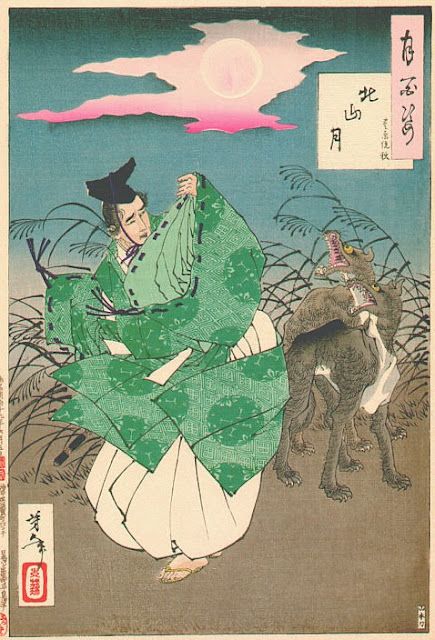
Why Is Takeshi Known as “the Wolf”? The novel never explains the origin of the epithet, but to Western readers the answer seems obvious: his predatory nature, on full display from the very first chapter when he led the raid on Yasuda village. Yet how did Japanese culture actually perceive the wolf?
In Europe, the wolf was firmly an animal of evil (the Beast of Gévaudan, the wolf Fenris, Little Red Riding Hood’s wolf, among many others), but in Japan it carried a far more ambivalent meaning. On one hand, it could be the predator that attacked travelers, particularly in the mountains: the okuri okami, often called okuri inu, since the line between dog and wolf was frequently blurred. But the okuri okami could just as easily appear as a protector, sometimes unconsciously (while it followed you, other creatures and even yokai kept their distance) and sometimes quite deliberately.
This duality as both predator and protector seems rooted in a fundamental difference between the two cultures. The greater prevalence of livestock farming in Europe made the wolf a natural enemy, while in Japan it could actually benefit agricultural communities by keeping in check the populations of herbivores and omnivores that ravaged crops. At times the wolf appears as a divine messenger, or even as the earthly form of certain gods.
Despite lacking the purely predatory reputation it carried in Europe, the wolf was still feared and respected. The legendary swordsmen known as the Shinsengumi were called “the Wolves of Mibu.” In The Yanagita Kunio Guide to the Japanese Folk Tale, we find the story of an elderly couple who count the wolf among their deepest fears. One might point out that both examples belong to the Meiji era, when attitudes toward the wolf had already soured considerably, but this was never meant to be an academic study of the wolf in Japanese culture. The goal is simply to answer the question I posed at the outset: Takeshi earns his epithet through the fear the wolf inspires, independent of its purely predatory associations.
The duality of the okuri okami predates the Meiji era, and as the author, it was precisely that duality that drew me to the epithet. Throughout the novel we see both sides at work: ferocity toward the enemy, and an unwavering loyalty and protective instinct toward his own. It also maps onto his arc as a character: a journey that begins in destruction and ends in something harder to define, as Takeshi becomes, against all odds, a guardian to the benevolent Zasuro.
There is something about the wolf that has always captured the human imagination across cultures, feared and revered in equal measure. I hope readers bring that same complicated fascination to our protagonist, because Takeshi, much like the animal whose name he carries, resists any simple reading.




Leave a Reply